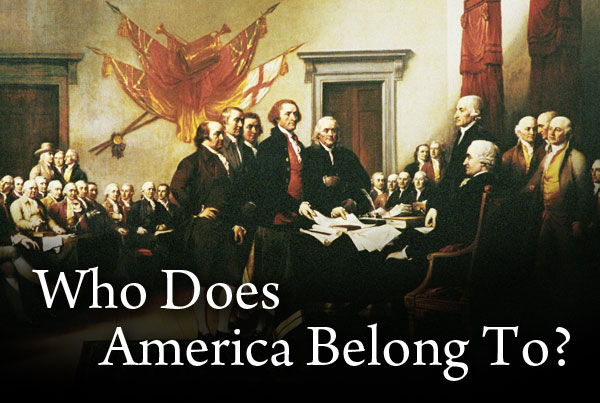
With the recent midterm elections, many within the mainstream conservative movement, especially represented by the Tea Parties, have asserted that we Americans need to “take our country back” from the politicians in Washington. This of course prompts the question of who “we” are and what it would mean to take “our” country back.
Inevitably, those within the mainstream right simply advocate voting for the Republican party or for candidates who promise to rein in spending, stop amnesty for illegal immigrants, and cut taxes. Even when Republicans are elected, there is the invariable disappointment that comes shortly after victory when entitlement programs are not rolled back. It is far too easy for leftists to brand Tea Partiers or other mainstream conservatives as racist because of the perceived over-representation of white people at rallies or other engagements. So the Tea Party and Republican party make it their top priority to appeal to minorities, rather than continuing to advocate for limited government and fiscal responsibility. By taking this approach, folks within the Tea Party or other movement conservative organizations actually legitimize the criticisms of the left who argue that minority participation and involvement is a prerequisite for political legitimacy. In the process, movement conservatives have lost sight of their original stated goals and platforms. By capitulating to politically correct standards, movement conservatives are willing to sacrifice their own interests in favor of the interests of others. Movement conservatism will continue to fail, and several election cycles have been wasted on trying to make a multi-racial nation (an oxymoron) work. So all of this leads us to ask the question, who does America belong to?
One of the chief distinctions that must to be brought up is the difference between a nation and a country. A country is geographic and political in nature, and is a group of people who occupy the same territory and share a common government. A nation constitutes a group of people who share common ethnic origin, and usually implies common culture, religion, and language. Ideally countries and nations would overlap as much as possible, but there are historic and contemporary examples when this is not the case. After the Second World War, and during the Cold War between the Soviet Union and America, the nation of Germany was divided up into the separate countries of East and West Germany. The nation of Korea remains divided into North and South Korea for political reasons to this day. There are also several examples, both historical and modern, in which multiple nations occupy the same country. The Roman Empire is a classic example. The distinction between nations and countries or governments is one that is also recognized in the Bible. Christ distinguished between nations and kingdoms when he predicted in the Olivet Discourse that nation would rise against nation, and kingdom would rise against kingdom.1 Both Old and New Testaments use separate words for nations and kingdoms.2
The traditional understanding of the American national identity was that Americans were white Europeans, and this fact was reflected in national policy. America was founded as a result of permanent English colonization of what became known as the North American continent. Colonial charters were clearly written for the English people, and there was no confusion about the national identity of the colonists. The Mayflower Compact establishing the Plymouth Colony was addressed to “our Dread Sovereign, King James,”3 indicating that the Plymouth colonists still possessed the notion that their migration to a different continent had not changed their national identity.
The Problem of Indian Presence Before Permanent European Settlement
The American identity is rationalized in different ways by the standard bearers of various political worldviews. Interestingly enough, despite different presuppositions, essentially all current mainstream political parties in America happen to agree that America has no particular racial or ethnic identity and that we are a unique propositional nation rooted in common ideas. The most prevalent reason for the perceived need to accept America as a propositional nation is the problem of Indian occupation of the North American continent prior to permanent modern European colonization. Liberals, mainstream conservatives, and most libertarians believe that America must not define itself racially as a means of rationalizing the supposed theft of the land from Indians. Instead of viewing America as an extension of the European people, we are led to believe that American identity is based upon a confluence of all different races present on the North American continent, and that we should allow open and unrestricted immigration to this country as a way of atoning for our exclusive past. The underlying problem with this viewpoint is that it is based upon a faulty understanding of American history.
The first problem with this theory is that there is substantial archeological evidence that suggests that the first settlers on this continent were Europeans. Discoveries of both artifacts and bodies too old to be from recent European settlers have confirmed that the oldest inhabitants of this continent were European. Only progressively did European settlers become displaced by “Indian” settlers.4
The second problem involves the foundationless theory that European settlers from the late fifteenth century onward simply stole Indian land. Contrary to popular mythology, Indian tribes did have a concept of land ownership, and had an extensive history of savage warfare amongst each other for possession of land and resources. European settlers were not always sinless in their dealings with the native Indians, but did make a conscious effort to settle in unoccupied territory and legitimately buy land claims from the Indian tribes who were here.5 There was no centrally planned “Indian genocide” by European settlers.6
History of U.S. Policy and Opinion
From the beginning of America’s political independence from England, Americans have asserted their distinct identity from the Indians on this continent. The Declaration of Independence decries that the king had “endeavored to bring on the inhabitants of our frontiers, the merciless Indian savages, whose known rule of warfare, is undistinguished destruction of all ages, sexes and conditions.”7 When the Constitution was ratified, apportionment of the states for representation in Congress and for the purpose of taxation was based upon population of free persons in each state. Indians were excluded seeing as they were not considered citizens, and other persons (those who were not freemen) counted as three-fifths toward the population.8 Indeed, the Preamble to the Constitution states that it was ordained by the people of the United States “to ourselves and our Posterity,” meaning that it was never intended to be a universal government for all mankind. John Jay wrote in defense of the Constitution that Americans could be politically united because Americans were already one united people.
With equal pleasure I have as often taken notice that Providence has been pleased to give this one connected country to one united people — a people descended from the same ancestors, speaking the same language, professing the same religion, attached to the same principles of government, very similar in their manners and customs, and who, by their joint counsels, arms, and efforts, fighting side by side throughout a long and bloody war, have nobly established general liberty and independence.9
As soon as the Constitution was ratified and the new government was established, the white European basis for the American identity was immediately reflected in public policy. The first law on immigration and naturalization as an American citizen was signed by President George Washington. This law limited naturalized citizenship to “free white persons of good moral character.”10 Early Americans had no illusion of a propositional identity, but rather understood their identity to be rooted in their European heritage. Policy continued to be based upon the America’s white European identity throughout our history.
For much of American history, the meaning of “free white persons” was obvious. “Free white persons” must be restricted to whites of European descent. The meaning of this term was clarified further by a Supreme Court case in 1923. An immigrant from India named Bhagat Singh Thind applied for citizenship citing the fact that as an Indian, modern anthropologists considered him to be a Caucasian. This was due to an ancient Aryan migration into the Indian subcontinent. Since white people were also considered to be Caucasians, Mr. Thind argued that he should be considered eligible for citizenship. The Supreme Court denied him citizenship explaining that the common, original, and colloquial definition of a white person was obvious, anthropological taxonomy notwithstanding. The decision explained: “the average man knows perfectly well that there are unmistakable and profound differences” between whites from Europe and Indians.11
The Immigration Act of 1924 was also a powerful effort at maintaining America’s ethnic identity. This act was also called the Johnson-Reed Act (and it included the National Origins Act and Asian Exclusion Act), which was passed due to fears that continued immigration would swamp America’s population. The act limited immigration from Europe based upon the proportion of the population in 1890. This meant that northern Europeans were greatly favored as immigrants to southern and eastern Europeans. Those not eligible for naturalized citizenship based upon the Naturalization Act of 1790 mentioned above were no longer eligible for immigration. Previously, Chinese workers were imported for manual labor, even though they would not become naturalized citizens. The Immigration Act of 1924 was the final step in the process insuring that this would no longer be the case.12
Thomas Jefferson, the principal author of the Declaration, stated that “the Anglo-Saxons are our ancestors, and we owe to them something of our characteristics, attitudes, and institutions.”13 Jefferson was very motivated to preserve the Anglo-Saxon heritage of the American people and their institutions. He maintained that American institutions could not be maintained apart from an appreciation of our ancestors who created them. He worked for years on an Anglo-Saxon grammar book for university students and designed a seal with the two great Saxon warriors on it, Hengst and Horsa.
America’s essentially white European identity was maintained into the twentieth century. President Theodore Roosevelt wrote in a letter to the American Defense Society:
We have room for but one language here, and that is the English language, for we intend to see that the crucible turns our people out as Americans, of American nationality, and not as dwellers in a polyglot boarding-house; and we have room for but one soul [sic] loyalty, and that is loyalty to the American people.14
Roosevelt demonstrated that he was concerned for the preservation of the American identity. It is clear from Roosevelt’s perceptions that he believed that Americans were comprised of people from European extraction.
There is no room in this country for hyphenated Americanism. When I refer to hyphenated Americans, I do not refer to naturalized Americans. Some of the very best Americans I have ever known were naturalized Americans, Americans born abroad. But a hyphenated American is not an American at all. . . . The one absolutely certain way of bringing this nation to ruin, of preventing all possibility of its continuing to be a nation at all, would be to permit it to become a tangle of squabbling nationalities, an intricate knot of German-Americans, Irish-Americans, English-Americans, French-Americans, Scandinavian-Americans or Italian-Americans, each preserving its separate nationality, each at heart feeling more sympathy with Europeans of that nationality, than with the other citizens of the American Republic. . . . There is no such thing as a hyphenated American who is a good American. The only man who is a good American is the man who is an American and nothing else.15
Historically, blacks in America were referred to as “colored” people or “negroes,” and this was by no means disrespectful. Only recently have blacks become known as “African-Americans.” This is nothing more than a politically correct overture, and it is certainly noteworthy that few people find it necessary to refer to white people as European-Americans, since white people were synonymous with the unhyphenated American identity to which President Roosevelt was referring. “African-American” is really a silly concept, since it is always used to refer to blacks anyway. No South African Boer or white Rhodesian who moves to America is ever considered to be an “African-American” in spite of the fact that their family resided in Africa for centuries. (Just ask yourself if it would make sense to refer to actress Charlize Theron as an “African-American.”) Up until the so-called “civil rights” legislation of the 1960s, no one had any difficulty identifying who Americans were, because the consensus from the time of the nation’s founding had been that Americans were white. American demographics reveal that America was over 90% white when “civil rights” legislation took effect. Up to this point, Americans were roughly as homogenous and easily identifiable as the Chinese!
Perhaps one of the most poignant defenses given of America’s white identity was by South Carolina Senator John C. Calhoun. In a speech before Congress in 1848 warning against the annexation of Mexican territories, Calhoun stated:
I know further, sir, that we have never dreamt of incorporating into our Union any but the Caucasian race–the free white race. To incorporate Mexico, would be the very first instance of the kind of incorporating an Indian race; for more than half of the Mexicans are Indians, and the other is composed chiefly of mixed tribes. I protest against such a union as that! Ours, sir, is the Government of a white race.16
Much could be said about the history of slavery and the debate over its morality in American history. It is noteworthy that one of the first formal arguments made against slavery and the importation of African slaves was made by Benjamin Franklin. Franklin wrote that he was concerned that Americans should be selective about who is let into the country. He argued that the importation of African slaves would darken the complexion of America. Franklin argued:
[T]he Number of purely white People in the World is proportionably very small. All Africa is black or tawny. Asia chiefly tawny. America (exclusive of the new Comers) wholly so. And in Europe, the Spaniards, Italians, French, Russians and Swedes, are generally of what we call a swarthy Complexion; as are the Germans also, the Saxons only excepted, who with the English, make the principal Body of White People on the Face of the Earth. I could wish their Numbers were increased.17
Franklin concludes his essay by observing that he was “partial to the Compexion of my Country, for such Kind of Partiality is natural to Mankind.”18 Franklin’s preference for his own people and his definition of his country along ethnic lines are natural among all of humanity. Indeed, Ben Franklin’s sentiments are “natural affections” that our degenerate age is lacking.19
During the famous senatorial debates between Stephen Douglas and Abraham Lincoln in Illinois, both candidates seemed committed to America’s white identity. Douglas, who was Lincoln’s opponent in the Senate campaign of 1858 stated a similar view of the American identity.
For one, I am opposed to negro citizenship in any and every form. I believe this government was made on the white basis. I believe it was made by white men, for the benefit of white men and their posterity forever, and I am in favor of confining citizenship to white men, men of European birth and descent, instead of conferring it upon negroes, Indians, and other inferior races.20
Lincoln later had to respond to the criticism of his liberalism on the issues of race and the American identity.
I will say then that I am not, nor ever have been in favor of bringing about in anyway the social and political equality of the white and black races–that I am not nor ever have been in favor of making voters or jurors of negroes, nor of qualifying them to hold office, nor to intermarry with white people; and I will say in addition to this that there is a physical difference between the white and black races which I believe will forever forbid the two races living together on terms of social and political equality. And inasmuch as they cannot so live, while they do remain together there must be the position of superior and inferior, and I as much as any other man am in favor of having the superior position assigned to the white race. I say upon this occasion I do not perceive that because the white man is to have the superior position the negro should be denied everything.21
Lincoln certainly wavered shortly after this as a result of his willingness to adapt his positions for the sake of political expediency. Douglas would go on to win the senatorial election, but only to lose to Lincoln in the presidential election two years later. Only recently has American policy changed, reflecting the new belief that America is a propositional nation.
Concluding Thoughts on the American Identity
In his famous speech, Senator Calhoun warned:
The greatest misfortunes of Spanish America are to be traced to the fatal error of placing these colored races on an equality with the white race. That error destroyed the social arrangement which formed the basis of society. . . . And yet it is professed and talked about to erect these Mexicans into a Territorial Government, and place them on an equality with the people of the United States. I protest utterly against such a project. Sir, it is a remarkable fact, that in the whole history of man, as far as my knowledge extends, there is no instance whatever of any civilized colored races being found equal to the establishment of free popular government, although by far the largest portion of the human family is composed of these races. And even in the savage state we scarcely find them anywhere with such government, except it be our noble savages–for noble I will call them. They, for the most part, had free institutions, but they are easily sustained among a savage people. Are we to overlook this fact? Are we to associate with ourselves as equals, companions, and fellow-citizens, the Indians and mixed race of Mexico? Sir, I should consider such a thing as fatal to our institutions.22
This certainly seems like overly harsh language by today’s standards. No senator would dare show such bravado while addressing Congress today. Yet Senator Calhoun’s warnings ring just as true today as they did a century and a half ago. There can be no doubt where our ancestors stood on the question of the white European basis of the American identity. This opinion was unanimously held by generations of Americans in spite of divisions on several political issues. The homogenous basis of America’s identity was challenged as part of the conquest of the South during the 1860s. Still, America’s identity remained strong until the outbreak of the Marxist-inspired civil rights movement. The concept of propositional nationhood does not have its foundation in history, experience, tradition, or Scripture. Israel, which is the example given in the Bible for godly nationhood,23 was itself “reckoned by genealogies.”24 Do we in America believe that we will be successful by breaking this Biblical precedent? The Soviet Union attempted a propositional nation, bound by the abstract principles of Marxism, and it failed due to internal chaos and breakdown of authority. Do we think that our experiment into propositional nationhood will fare any better than our Marxist predecessors in the Soviet Union? The Soviet Union did not sustain itself as a pluralist, multi-racialist empire, and neither will the United States. The Soviet Union was judged by God, and this judgment resulted in the breakup of the Soviet territories into their original ethnic states. Even in His acts of judgment, we can see God’s mercy. May God be so merciful to these once great United States of America.
Footnotes
- Matt. 24:7, cf. Mk. 13:8, Lk. 21:10 ↩
- See Strong’s Concordance: Nation – H1471, G1484; Country – H776, G3714 ↩
- Text of the Mayflower Compact available at: http://www.allabouthistory.org/mayflower-compact.htm ↩
- See Kemp, Arthur: March of the Titans: A History of the White Race. Chapter 6: To the Ends of the Earth – Lost White Migrations. http://www.white-history.com/hwr6b.htm ↩
- See Woods, Thomas. The Politically Incorrect Guide to American History. The Colonial Origins of American Liberty. pp. 6-9 ↩
- See also Jackson, Thomas. White Men Meet Indians: Jamestown and the Clash of Civilizations. Review of David A. Price, Love and Hate in Jamestown: John Smith, Pocahontas, and the Heart of a New Nation, Alfred A. Knopf, 2003. http://www.amren.com/ar/2004/01/index.html#article2 ↩
- The Declaration of Independence: http://www.earlyamerica.com/earlyamerica/freedom/doi/text.html ↩
- United States Constitution: Article 1, Section 2 ↩
- John Jay. Federalist Number 2 ↩
- Naturalization Act of 1790. See http://en.wikipedia.org/wiki/Naturalization_Act_of_1790 ↩
- U.S. vs. Bhagat Singh Thind. http://historymatters.gmu.edu/d/5076/ ↩
- Immigration Act of 1924. See http://en.wikipedia.org/wiki/Immigration_Restriction_Act_of_1924 ↩
- Jefferson, Thomas cited in Crossley-Holland, Kevin. The Anglo-Saxon World: An Anthology. Oxford: Oxford UP, 1984. ↩
- President Theodore Roosevelt. Letter to the American Defense Society. January 3, 1919. http://www.truthorfiction.com/rumors/r/roosevelt-immigration.htm ↩
- Roosevelt Bars the Hyphenated. NY Times, October 13, 1915. http://query.nytimes.com/mem/archive-free/pdf?res=9901E0DD1239E333A25750C1A9669D946496D6CF ↩
- Calhoun, John. Speech before Congress. 1848. The Annexation of Mexico. http://teachingamericanhistory.org/library/index.asp?document=478 ↩
- Franklin, Benjamin. Observations Concerning the Increase of Mankind, Peopling of Countries, etc. 1751. http://bc.barnard.columbia.edu/~lgordis/earlyAC/documents/observations.html ↩
- Ibid. ↩
- Rom. 1:31, 2 Tim. 3:3 ↩
- Douglas, Stephen. Speech during the First Debate with Abraham Lincoln at Ottawa, Illinois, August 21, 1858. http://www.sonofthesouth.net/slavery/abraham-lincoln/stephen-a-douglas-speech-debate.htm ↩
- Fourth Debate with Stephen A. Douglas at Charleston, Illinois, September 18, 1858. The Collected Works of Abraham Lincoln edited by Roy P. Basler, Volume III, pp. 145-146. http://quod.lib.umich.edu/cgi/t/text/text-idx?c=lincoln;idno=lincoln3;rgn=div2;view=text;cc=lincoln;node=lincoln3%3A20.1 ↩
- Calhoun, John. Speech before Congress. 1848. The Annexation of Mexico. http://teachingamericanhistory.org/library/index.asp?document=478. See http://www.flowofhistory.org/themes/movement_settlement/uspolicytimeline.php for further details on the history of American policies on race, immigration, and naturalization. ↩
- Deut. 4:5-7 ↩
- 1 Chr. 9:1 ↩
| Tweet |
|
|
|