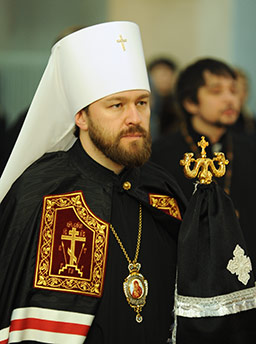
Late last year, Metropolitan Hilarion of Volokolamsk of the Russian Orthodox Church gave a speech at the annual Nicean Club Dinner as part of the ongoing dialogue between the Russian Orthodox and Anglican churches. The thesis of this speech was that the divide in Christendom is increasingly between liberals and traditionalists rather than between the individual branches of the Faith. The speech is well worth reading. Although you might find the Anglican-Russian history a bit boring, the thought-provoking overarching premise makes up for it. You can find the transcript of the speech here. Some excerpts:
All current versions of Christianity can be very conditionally divided into two major groups – traditional and liberal. The abyss that exists today divides not so much the Orthodox from the Catholics or the Catholics from the Protestants as it does the ‘traditionalists’ from the ‘liberals’. Some Christian leaders, for example, tell us that marriage between a man and a woman is no longer the only way of building a Christian family: there are other models and the Church should become appropriately ‘inclusive’ to recognize alternative behavioural standards and give them official blessing. Some try to persuade us that human life is no longer an absolute value; that it can be terminated in a mother’s womb or that one can terminate one’s life at will. Christian ‘traditionalists’ are being asked to reconsider their views under the slogan of keeping abreast with modernity. . . .
What can [liberal] churches say to their faithful and to secular society? What kind of light do they shine upon the world (cf. Mt. 5:14)? What is their ‘salt’? I am afraid the words of Christ can be applied to them: If the salt loses its saltiness, how can it be made salty again? It is no longer good for anything, except to be thrown out and trampled by men (Mt. 5:13).
We are aware of the arguments used by proponents of the above-mentioned liberal innovations. Tradition is no authority for them. They believe that to make the words of Holy Scripture applicable to modernity they have to be ‘actualized’, that is, reviewed and interpreted in an appropriate, ‘modern’ spirit. Holy Tradition is understood as an opportunity for the Church to be continually reformed and renewed and to think critically.
The Orthodox, however, have a different understanding of Holy Tradition. It is aptly expressed in the words of Vladimir Lossky: ‘Tradition is the life of the Holy Spirit in the Church – the life giving to every member of the Body of Christ the ability to hear, accept and know the Truth in its inherent shining, not in the natural light of human reason’. . . .
Summing up, I wish to assert that today we have new divisions in Christendom, not only theological but also ethical.
Am I trying to say that the theological differences between the branches of Christianity are unimportant? Certainly not. I affirm, rather, that I, as a conservative, traditional Reformed Presbyterian, have much more common ground when it comes to cultural, moral, and civilizational issues with a traditional Catholic or a traditional Orthodox or a traditional member of another Protestant denomination than I do with a liberal Presbyterian. This is one of the main reasons that Faith and Heritage takes a non-denominational stance; theology is very important, but there are literally hundreds and hundreds of sites where you can discuss theology, while there are very, very few sites discussing issues related to Western Civilization from a pro-European, traditional, Christian perspective. Individual authors will of course bring their own theological views into the articles they write, and differences of opinion can be expressed civilly in the comments. That is fine, but the goal of this site is to address cultural, moral, and civilizational issues in a way that most traditional Christians can agree upon, not to fix the schisms in Christianity.
| Tweet |
|
|
|