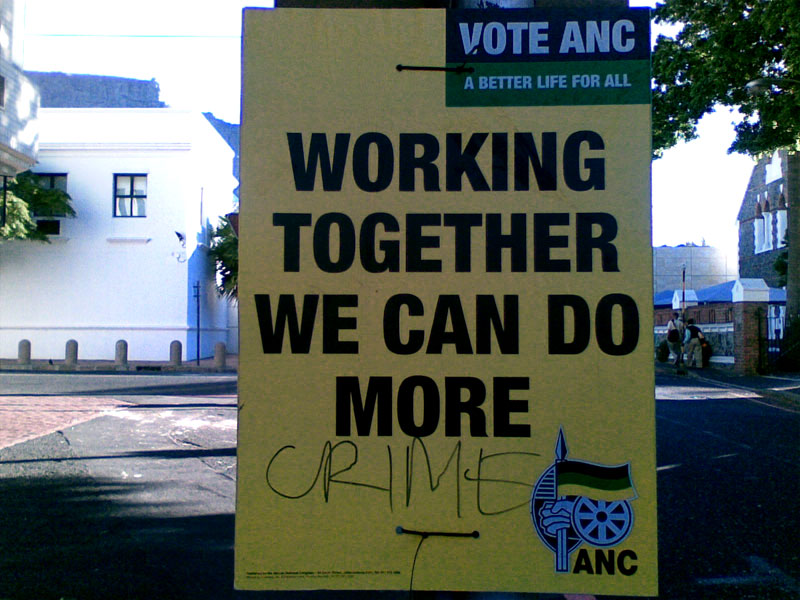
On the 18th of May, South African citizens went to the polls to cast their votes in the 2011 municipal elections. Voter turnout was extremely low — even lower than in previous elections, with just over half of registered voters going through the effort to actually cast their votes, which amounts to about 40% of all eligible voters.1 As expected, the Marxist African National Congress achieved yet another comfortable victory, receiving 62% of the votes, with the centre-left Democratic Alliance in second place, gaining just over 24% of the votes nationally. The DA did achieve its goal in retaining control over the city council of Cape Town, receiving over 60% of the votes in the most liberal-voting of the major South African cities.2 This is also largely due to the success of the Cape Town government under the leadership of DA party leader Helen Zille over the past few years, when she improved the infrastructure and socio-economic conditions of the city. This was the DA’s best showing in any election ever, with the ANC remaining firmly in control of the country as a whole.
In a country where 80% of the population is black, it is roughly estimated that the party received about 75% of the black votes. The DA’s support base should (by my own estimates) be more multiracial, with whites, coloureds (mixed-race people and khoisan) and blacks about equally represented. White South Africans make up nearly 10% of the population and voters, and this was their most liberal vote ever, with an estimated 85% of white voters opting for Helen Zille’s DA. The Inkatha Freedom Party, a Zulu nationalist party, was in a distant third position, at about 4%. No other party managed to get more than 2.5% of the national vote. The only conservative Afrikaner-nationalist Christian party that participated in this election was the Freedom Front Plus, who received only about 0.5% of the national vote and 2.7% in my home metropolis, Bloemfontein.3
A lot of political commentators have predicted that this was the last election for the minor parties and that South Africa is now gradually moving toward a two-party system. The percentage of voters who voted for the two leading parties have increased from 80% in 2000 to 86% in 2011, and some expect this figure to rise even further in future. Unfortunately for the DA, despite substantially increasing their ward-victories in this election, they have generally failed to win over significant numbers of voters from the ANC, and most of their increased support come at the cost of minor parties, despite the liberal media’s suggesting otherwise. In the 2009 general election, the ANC received 66% of the vote, compared to the DA’s 17%.4 This has led many to believe that this was the last election that the two leading parties would receive less than 90% of the vote combined, virtually eliminating the other parties.5
Zille, in fact, also proudly proclaimed after the election that the DA virtually destroyed the FF+ with their effective campaign tactics. Should Zille be correct (and I see no reason she is not), this election has effectively signified the end of right-wing party politics in South Africa. The Freedom Front has always received criticism from both paleoconservatives and the extreme right on being too pragmatic in their approach to politics in the new South African liberal democracy, largely contributing to its downfall. I, for example, recall FF+ leader Pieter Mulder’s praises of former president Nelson Mandela during a parliamentary speech a few years ago, without even mentioning Mandela’s abundance of faults: previous illegal and violent terrorist activities of the early 1960s (for which he was rightfully sentenced to prison), his Marxist outlook,6 and his anthropocentric religious views. These all are things which no true Christian should overlook when assessing a political figure. Furthermore, the party has in recent years failed to vocally take a kinist stand against the evils of racial integration and increasing miscegenation in the country, instead building its policies around the liberal concept of “minority rights.”
The major far right-wing party in South Africa, the Reconstituted National Party (holding to some racial supremacist and imperialist views), suffered a split in 2007, when the breakaway Afrikaner People’s Party was formed. Both these parties have refused to participate in the IEC’s elections, but the split has severely weakened the far-right as well.7
Other small conservative Christian Parties also crumbled in this election, with the African Christian Democratic Party not even managing to get more votes than the FF+. All this indicates that in future elections, voters will have to choose between the liberal DA, with its secular humanist and cultural Marxist approach, and the black socialist ANC. For a Christian, this is a bit like choosing between attending a church service led by Oprah Winfrey and one featuring Joel Osteen. Although one can probably say which one sounds a bit closer to home, both are unacceptable to the biblical worldview.
The cause of the fall of the right in South Africa is no mystery, however. Since the collapse of the Conservative Party in the mid 90s, no political party has truly represented paleoconservatives at any level. They have, for all practical purposes, withdrawn themselves from national elections and party politics. I actually voted for the first time on the 18th of May, but my father, despite being a registered voter and accompanying my mom to the voting station, did not bother voting. In an overwhelmingly black country, with a communist-minded party governing, and with the same electoral commission overseeing both South Africa and Zimbabwe’s elections, I really don’t blame them. Furthermore, the only party a freedom-loving Boer could seriously consider voting for, the Freedom Front, severely suffers from this old sickening liberal principle of practical atheism — that once we have started off proceedings with a prayer and the acknowledgment of God, we should turn our attention to the practical matters and put Christ’s kingdom at the back of our minds. They do not live and practice politics in complete dependence on the Almighty as the sustainer and preserver of every molecule in the universe. Although there is probably still some good in this approach, also followed by the Reconstituted National Party over the years, it holds no long-term solution to the problems that the Bible-believing Christian wishes to address in political sphere. Furthermore, with the fall of the FF+, Conservative Afrikaners aren’t really free to vote according to the biblical principles laid out in Ex. 18:21 anymore. The criteria this verse lays out for eligible candidates are that they should be chosen from one’s own people (kin) and that they should be God-fearing men of truth, but candidates that run for office on either a DA or ANC ballot are certainly not viable options when measured by these biblical criteria. Consequently, there is certainly merit in rejecting all the political parties in South Africa at the moment.
All this being said, God works all things to the good of His children (Rom. 8:28) and there are a lot of positives to be taken even out of this situation. With the fall of right-wing party politics, white Afrikaners now have no political institution to put their trust in, as they had during the National Party’s heyday of the 1970s and 80s. Much like Old Testament Israel in captivity, we can now literally, even humanly speaking, turn only to God to liberate us from this godless political system (cf. Psalm 146:3-5). Also, Jeremiah writes in Lamentations 5, concerning the Israelites, that their inheritance has been turned over to aliens, their houses to foreigners, and their land to foreign peoples — and worse, that servants rule over them (vv. 3-7). The same can be said of the Afrikaner-Boer people today, including that there is none who can deliver us from the foreign power but the Lord our God (vv. 19-20). Our Savior is the same and only God in whom there is eternal salvation.

Footnotes
- http://www.news24.com/SouthAfrica/Local-Elections-2011/Voter-turnout-highest-ever-IEC-20110521 ↩
- http://en.wikipedia.org/wiki/South_African_municipal_election,_2011#Election_Results ↩
- http://www.dieburger.com/Suid-Afrika/Nuus/Lede-van-VF-laat-weet-hulle-kan-met-Helen-Zille-wen-20110520 ↩
- http://en.wikipedia.org/wiki/2009_south_african_general_election ↩
- http://www.beeld.com/MyBeeld/Briewe/Afrikaner-gaan-nog-hare-uit-die-kop-trek-oor-verspeelde-kanse-20110520 ↩
- http://plaintruthmagazine.blogspot.com/2008/06/stop-terrorist-nelson-mandela.html ↩
- http://www.stormfront.org/forum/t219395/ ↩
| Tweet |
|
|
|