Against Free Trade

June 28, 2012 Blog, Economics, Ideology, Politics Print Page

Merchants have no country.  The mere spot they stand on does not constitute so strong an attachment as that from which they draw their gains.” – Thomas Jefferson


There have been some really great articles recently attacking the deeply flawed ideology of free trade which are definitely worth your time to read through.

Pat Buchanan discusses what disastrous things the recent free trade agreement with South Korea is doing to our economy:

Well, courtesy of Martin Crutsinger of the Associated Press, the trade figures are in for April, the first full month under the trade deal with South Korea.

And, surprise! The U.S. trade deficit with Korea tripled in one month. Imports from South Korea jumped 15 percent to $5.5 billion in April, while U.S. exports to South Korea fell 12 percent to $3.7 billion. Suddenly, the U.S. trade deficit with Seoul surged to an annual rate of $22 billion.

Shades of NAFTA. When it passed in 1993, we had a $1.6 billion trade surplus with Mexico. By 2010, our trade deficit with Mexico had reached $61.6 billion. . . .

A deepening dependence on foreign nations for the necessities of our national life. A steady erosion of our manufacturing base. A continued stagnation in the real wages of the middle class. And an unending redistribution of America’s wealth to foreign lands.

It is no coincidence that the real wages of U.S. workers ceased to rise in the mid-1970s, just as a century of U.S. trade surpluses was coming to an end. . . .

Instead of a trade policy crafted for the benefit of multinationalist corporations, we need a new trade policy that puts America and Americans first.

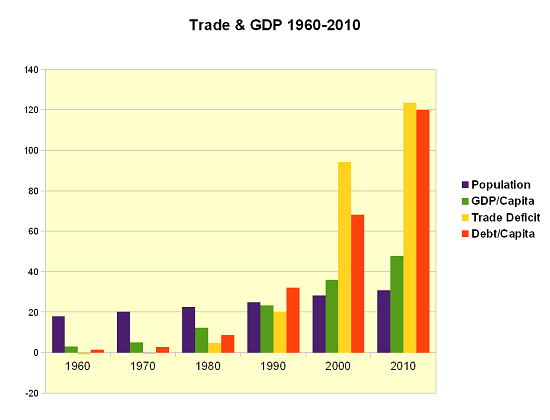
Vox Day expanded Buchanan’s analysis with a look at some actual numbers and graphs:

Notice how adding the overall debt level of the economy completely changes the picture and makes it obvious how the trade deficit is impoverishing the USA despite the increase in GDP. GDP that does not account for debt is a terrible measure of wealth and every bit as misleading as GDP that does not account for inflation, as it is nothing more than a metric intended to track national income. Whereas per capita wealth, measured by GDP/capita – debt/capita was only -$1,417 in 1960, it has increased by two orders of magnitude to -$120,014. Debt that could once be paid off in 17 months would now require 42 months.

The prosperity that North and others claim free trade has brought the USA is nothing but a mirage and is the simple result of Americans borrowing to buy those foreign goods and services with money they will have to pay back from a smaller industrial base competing against much more serious competitors than they faced 50 years ago.

The case for free trade was always logically flawed, and on the empirical level simply cannot survive the incorporation of debt into the equation, as the historical statistics clearly demonstrate the intrinsic falsity that was always apparent to the sufficiently careful economic analyst. Free trade has not made the USA more wealthy, any more than buying giant houses with no-money down mortgages during the housing boom made those individuals who bought them rich. It hardly amounts to “state worship” to note that debt is not wealth. And it should be clear that by depriving the local consumers of their jobs and their ability to pay for imported goods and services, free trade necessarily requires either a decline in living standards or a constantly increasing debt load for countries on the red side of the trade deficit.

Vox then followed this up with a discussion about how much of modern devotion to the ideology of free trade is religious in nature:

The chief legacy of David Ricardo’s free-trade doctrine, beyond its pernicious utilization by globalists and fascistic, anti-democratic organizations such as the European Union, is one of intellectual dishonesty. In Europe and the Americas, every so-called free-trade agreement has been signed over the objection of critics who object, correctly, that the effects will be precisely the opposite of those promised by those pushing the agreements. From the European Coal and Steel Community to NAFTA and the recent trade agreement with South Korea, the real objectives and eventual results have been very different from those promised. As Pat Buchanan demonstrated in his recent column titled “We need more economic nationalists,” free-trade doctrine fails catastrophically every time it is forced to prove itself as a predictive model. . . .

There are a variety of perspectives from which the free-trade doctrine can be considered. But it must not be forgotten that Ricardo was not an economist in the modern sense, and his works were political economy. There are arguments for and against free trade that are purely economic and theoretical, but they must be carefully distinguished from those that are practical, political and even moral. And when the advocates of free trade assert the intrinsic perfection of free trade on a moral basis, it should be recognized that this is not an economic argument, but rather a religious one.


Print Page

About Nathanael Strickland

Nathanael Strickland is the owner and chief editor of FaithandHeritage.com. He was born in Dallas, TX, grew up in upstate SC, and now resides in SE TX. He received both his BS in Political Science with a minor in Economics and his MBA from Clemson University and now works in project management, SEO, and web design. He has ancestors who fought with the patriots in the American Revolution, with the Texans at the Alamo, and with the Confederacy in the War for Southern Independence. You can reach him by email at editor [at] faithandheritage.com.

  • Howard Andrew

    Free trade is destroying the economic base of New Zealand too, yet all our political parties pursue it with religious fervour.

  • http://www.facebook.com/profile.php?id=100002942153351 Frederick Wigglesworth

    I’ve been following Vox’s posts on this subject closely. Very interesting stuff.

    Perhaps most interesting was Gary North’s weak attempt to defend free-trade. His “argument,” if you can call it that, amounted to little more than mockery, ridiculous assertion, and logical fallacy — it was pretty pathetic. Of course, North is such a committed cultural Marxist when it comes to the issue of race/ethnicity/nationhood, he doesn’t even see borders. For North, borders are nothing but invisible, arbitrary lines that serve no other purpose than to frustrate the free flow of goods and labor in the global marketplace.

    Anarcho-libertarianism is just globalism by another name. It’s this realization that has always prevented me from getting completely on-board the Ron Paul bandwagon. I think we can work within libertarianism to a certain degree; in many respects our goals are the same. But make no mistake: when it gets right down to it, libertarians are not our allies. They’ll just as soon sell out white America to the third world as the leftists.

    • Moon Buggy

      There’s a big difference. Libertarians will leave alone those they don’t agree with. True golbalists are basically Muslims with “race” replacing “allah”.

    • http://www.facebook.com/people/Karla-Brooks/100000680332877 Karla Brooks

       •Free Trade -> Misery -> Social Revolution. •(1) Karl Marx on Free Trade (2) Frederick Engels on Free Trade (3) Trotskyists for Free Trade •(1) Karl Marx on Free Trade •Karl Marx’s major statement about Free Trade was an address delivered to the Democratic association of Brussels, Belgium, on January 9, 1848, around the same time as he wrote the Communist Manifesto. •“Moreover, the Protective system is nothing but a means of establishing manufacture upon a large scale in any given country, that is to say, of making it dependent upon the market of the world: and from the moment that dependence upon the market of the world is established, there is more or less dependence upon Free Trade too. Besides this, the Protective system helps to develop free competition within a nation. Hence we see that in countries where the bourgeoisie is beginning to make itself felt as a class, in Germany for example, it makes great efforts to obtain Protective duties. They serve the bourgeoisie as weapons against feudalism and absolute monarchy, as a means for the concentration of its own powers for the realization of Free Trade within the country. •But, generally speaking, the Protective system in these days is conservative, while the Free Trade system works destructively. It breaks up old nationalities and carries antagonism of proletariat and bourgeoisie to the uttermost point. In a word, the Free Trade system hastens the Social Revolution. In this revolutionary sense alone, gentlemen, I am in favor of Free Trade.”http://mailstar.net/classwar.html •“Hence we see that in countries where the bourgeoisie is beginning to make itself felt as a class, in Germany for example, it makes great efforts to obtain Protective duties. They serve the bourgeoisie as weapons against feudalism and absolute monarchy, as a means for the concentration of its own powers for the realization of Free Trade within the country.” •Here he describes the American School of Economics, that promoted middle class [bourgeoisie] success. Free trade is a backdoor way to Communism. This is obvious when you look at our trade deficits with Communist China, Caste System India, Mexico and the pending agreement with Communist Brazil. The current Mexican Constitution was written by a Commie and the US considered Mexico Bolshevik until the 70s, when “free trade” became popular.

  • http://www.facebook.com/people/Karla-Brooks/100000680332877 Karla Brooks

     •The Report on Manufactures is the third report, and magnum opus, of American Founding Father and 1st U.S. Treasury Secretary Alexander Hamilton. It was presented to Congress on December 5, 1791 and recommended economic policies to stimulate the new republic’s economy and ensure the independence won with the conclusion of the Revolutionary War in 1783. •Since the “free traders” and and “libertarians” claim to be Constitutionalists, it is valid to point out that Article 1, Section 8 of the Constitution gives Congress the specific right to “regulate commerce with foreign nations”. America’s leaders did just that, until the 1970’s. •Hamilton’s “Report on Manufactures” laid forth economic principles rooted in both the Mercantilist System of Elizabeth I’s England and the practices of Jean-Baptiste Colbert of France. The principal ideas of the “Report” would later be incorporated into the “American System” program by Senator Henry Clay of Kentucky and his Whig Party. Abraham Lincoln, who called himself a “Henry Clay tariff Whig” during his early years, would later make the principles outlined in the “Report” and furthered by Clay’s “American System” program cornerstones, together with opposition to the institution and expansion of slavery, of the fledgling Republican Party. •Hamilton’s ideas formed the basis for the American School of economics.